
Fiber Optic Cables
What Are Fiber Optic Cables and How Do They Function?
In today’s digital world, fast and reliable communication is more important than ever. From browsing the internet and streaming videos to making video calls and running cloud-based applications, modern technology depends heavily on high-speed data transmission. One of the most important technologies enabling this connectivity is the Fiber optic cable.
Fiber-optic cables have revolutionized communication networks by providing faster speeds, greater bandwidth, and more reliable performance than traditional copper cables.
This article explains what Fiber optic cables are, how they function, their components, types, advantages, applications, and why they are considered the future of modern communication infrastructure.
What Exactly Is Fiber Optic Cable?
A Fiber optic cable, also known as an optical fiber cable, is a specialized communication cable that transmits information using light signals instead of electrical signals. These cables contain thin strands of glass or plastic fibers capable of carrying data over long distances at extremely high speeds.
Unlike conventional copper cables, which transmit electrical currents, fiber optic cables use pulses of light generated by lasers or LEDs. Since light travels faster and experiences less interference than electricity, fiber optic cables can deliver significantly higher bandwidth and faster data transfer rates.

Fiber optic technology supports data transmission speeds ranging from 10 Gbps to 100 Gbps and beyond, making it ideal for high-performance communication networks. Due to these capabilities, fiber optic cables are widely used in internet services, telecommunications, cable television networks,
data centers, enterprise networks, and smart city infrastructure.
Why Fiber Optic Cables Are Important?
The demand for internet connectivity continues to increase as more devices become connected through digital networks. Traditional copper-based networks often struggle to handle large volumes of data, especially over long distances.
Fiber optic cables address these challenges by offering:
- High-speed data transmission
- Large bandwidth capacity
- Long-distance communication
- Low signal loss
- Resistance to electromagnetic interference
- Improved Network Reliability
These advantages have made fiber optic technology the backbone of modern communication systems worldwide.
What Are Fiber Optic Cable Components?
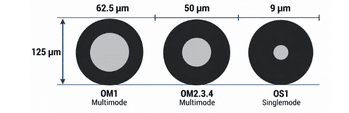
A fiber optic cable consists of several layers designed to protect the optical fiber and ensure efficient data transmission.
Each component plays a crucial role in maintaining signal quality and cable durability.
1. Core
The core is the central part of the fiber optic cable through which light travels.
Key features include:
1. Made from glass or plastic.
2. Carries optical signals.
3. Determines transmission performance.
4. Available in different diameters depending on the cabletype.
In single-mode fiber, the core is extremely small, allowing only one light path. In multimode fiber, the core is larger, allowing multiple light paths.
2. Cladding
The cladding surrounds the core and has a lower refractive index than the core material.
Its main purpose is to keep light trapped within the core through a phenomenon known as total
internal reflection.
Benefits of cladding include:
1. Prevents signal leakage.
2. Improves transmission efficiency.
3. Reduces signal loss.
4. Maintains signal integrity over long distances.
3. Buffer Coating
The buffer coating is a protective plastic layer applied around the cladding.
Functions include:
1. Protecting fibers from moisture.
2. Preventing physical damage.
3. Reducing stress during installation.
4. Increasing cable flexibility.
This layer ensures that the delicate optical fibers remain protected during handling and operation.
4. Strengthening Members
Fiber optic cables include strengthening materials to protect the fiber from tension and mechanical stress.
Common strengthening materials include:
1. Kevlar fibers
2. Aramid yarn
3. Steel wires
4. Fiberglass rods
These materials prevent the cable from stretching or breaking during installation and everyday use.
5. Outer Jacket
The outer jacket is the final protective layer of the cable.
Its purpose is to:
1. Protect against environmental damage.
2. Resist chemicals and moisture.
3. Prevent abrasion.
4. Provide UV protection for outdoor installations.
The jacket is often color-coded for easy identification of fiber types and applications.
How Fiber Optic Cables Function?
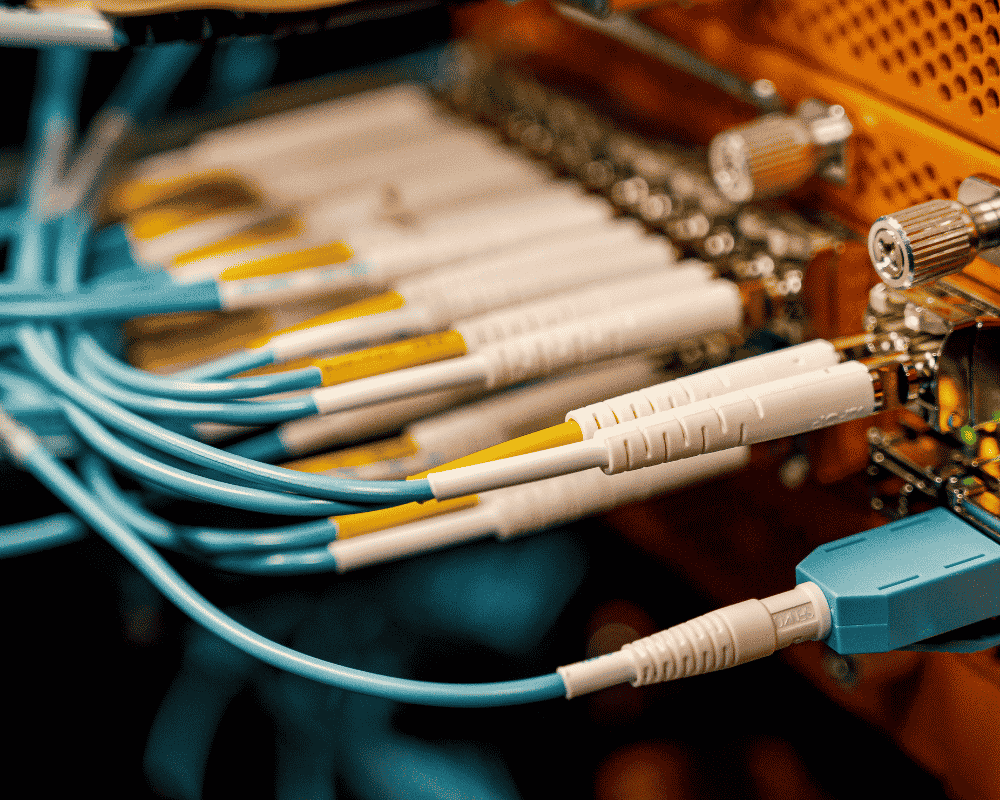
Fiber optic cables transmit information using light instead of electricity. The process may seem
complex, but it follows a simple principle.
Step 1: Data Conversion
When data needs to be transmitted, a transmitter converts electrical signals into light pulses.
This is typically accomplished using:
1. Laser diodes
2. Light-emitting diodes (LEDs)
Each pulse of light represents digital information.
Step 2: Light Transmission Through the Core
The generated light enters the fiber core and begins traveling through the cable. Because the core is made of highly transparent glass or plastic, light can travel long distances with minimal loss.
Step 3: Total Internal Reflection
As the light travels through the core, it repeatedly reflects off the cladding. This process is called total internal reflection, which keeps the light confined within the core even when the cable bends.
Total internal reflection allows fiber optic cables to:
1. Maintain signal strength.
2. Reduce attenuation.
3. Support long-distance communication.
Step 4: Signal Reception
At the receiving end, a photodetector converts the incoming light pulses back into electrical signals. These electrical signals are then processed by computers, networking equipment, or communication devices.
The entire process occurs almost instantaneously, enabling high-speed communication across vast distances.
Types of Fiber Optic Cables
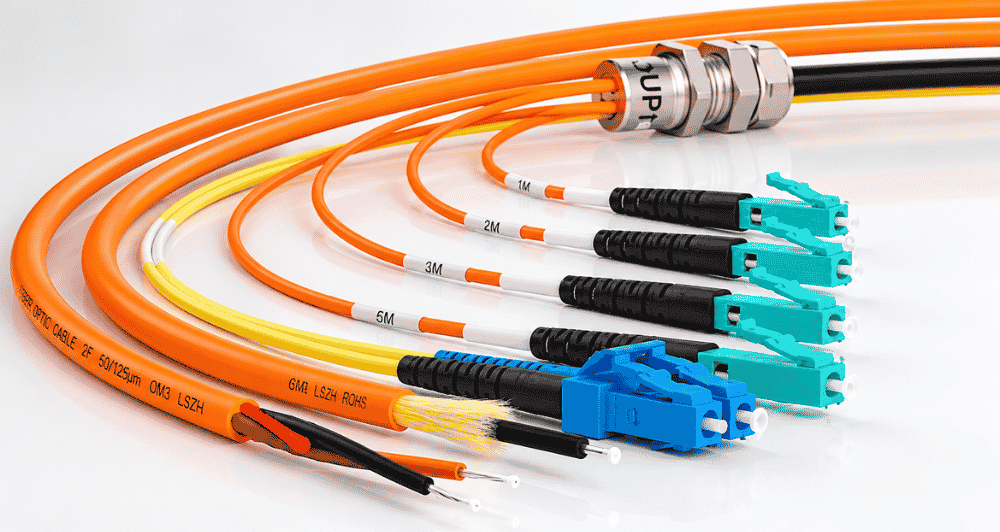
Fiber optic cables are generally classified into two main categories:
Single Mode Fiber (SMF)
Single mode fiber contains a very small core, typically measuring between 8 and 10 microns. Because of its narrow core, only one light path travels through the fiber.
Characteristics of Single Mode Fiber
Single mode fiber can support transmission distances exceeding 100 kilometers without significant
signal degradation.
- Core size: 8–10 microns
- Operates at 1310nm and 1550nm wavelengths
- Supports extremely long distances
- Minimal signal attenuation
- Reduced modal dispersion
- Higher bandwidth capacity
Applications of Single-Mode Fiber Single mode fiber is commonly used in:
- FTTH (Fiber to the Home)
- Long-distance telecommunications
- Internet backbone networks
- Metro Ethernet networks
- 5G infrastructure
- Data center interconnections
Multimode Fiber (MMF)
Multimode fiber features a larger core, typically 50 or 62.5 microns in diameter. This larger core allows multiple light paths to travel simultaneously.
Characteristics of Multimode Fiber
- Core size: 50 or 62.5 microns
- Operates at 850nm and 1300nm wavelengths
- Supports shorter transmission distances
- More affordable than SMF
- Easier to install and terminate
Types of Multimode Fiber Multimode fiber is available in several categories:
- OM1
- OM2
- OM3
- OM4
- OM5
Each category offers different performance levels and transmission distances.
Applications of Multimode Fiber Multimode fiber is commonly used in:
- Local Area Networks (LAN)
- Data centers
- Enterprise buildings
- Campus networks
- Audio-video systems
- Industrial communication networks
Transmission distances typically range from a few hundred meters to approximately 2 kilometers.
Advantages of Fiber Optic Cables
Fiber optic technology offers numerous advantages compared with traditional copper-based communication systems.
- High-Speed Data Transmission
Fiber optic cables support extremely high bandwidth and can carry vast amounts of data simultaneously. - Longer Transmission Distances
Signals can travel many kilometers without requiring amplification, making fiber ideal for long-distance communication. - Low Signal Loss
Fiber optic cables experience very low attenuation, ensuring reliable communication even over extended distances. - Resistance to Electromagnetic Interference
Unlike copper cables, fiber optics are immune to electromagnetic and radio-frequency interference. - Enhanced Security
Since fiber optic cables do not radiate signals, unauthorized interception becomes much more difficult. - Lightweight and Compact
Fiber optic cables are thinner and lighter than copper cables, simplifying installation and cable management. - Greater Reliability
Fiber optic networks are less susceptible to environmental factors, ensuring consistent performance.
Applications of Fiber Optic Cables
Fiber optic cables play a vital role in numerous industries and technologies.
- Telecommunications
Telecommunication companies use fiber optics to deliver voice, data, and internet services. - Internet Service Providers
High-speed broadband connections rely heavily on fiber optic infrastructure. - Data Centers
Modern data centers use fiber optics for rapid server-to-server communication. - FTTH networks
Fiber-to-the-Home technology provides ultra-fast internet directly to residential users. - Cable Television
Cable operators use fiber optics to deliver high-quality television signals. - Healthcare
Medical imaging equipment and hospital networks utilize fiber optic technology. - Military and Defence
Fiber optics provide secure communication systems for defence applications. - Smart Cities
Smart city projects use fiber optic networks to support surveillance, traffic management, public Wi-Fi, and IoT devices. - Industrial Automation
Manufacturing facilities rely on fiber optics for machine communication and automation systems.
Why choose UNISOL for fiber optic cables?
UNISOL is a trusted provider of high-quality fiber optic cable solutions designed to deliver reliable, high-speed, and future-ready connectivity for a wide range of networking applications. With extensive experience in fiber optic infrastructure, UNISOL offers durable and high-performance fiber optic cables suitable for telecom networks, FTTH deployments, data centers, enterprise networks, smart city projects, and industrial communication systems. UNISOL’s fiber optic cables are manufactured using premium-grade materials to ensure low signal loss, high bandwidth capacity, and long-distance data transmission.
The cables are designed to withstand challenging environmental conditions while maintaining stable network performance and reliability. The company provides a comprehensive range of single-mode and multimode fiber optic cables, enabling customers to choose the ideal solution based on their network requirements. UNISOL also offers expert technical support, professional installation guidance, and customized connectivity solutions to ensure seamless network deployment and operation.
With a strong focus on quality, innovation, and customer satisfaction, UNISOL delivers cost-effective Fiber optic solutions that support faster communication, improved network efficiency, enhanced scalability, and long-term performance for modern digital infrastructure.
Conclusion
Fiber optic cables have transformed the way information is transmitted across modern communication networks. By using light signals instead of electrical signals, they deliver significantly faster speeds, higher bandwidth, greater reliability, and longer transmission distances than traditional copper cables.
Understanding the components of Fiber optic cables, including the core, cladding, buffer coating, strengthening members, and outer jacket, helps explain how these advanced cables function. Whether using single-mode Fiber for long-distance communication or multimode Fiber for local networking applications, Fiber optic technology remains the foundation of modern telecommunications, data centres, internet services, and smart infrastructure.
As the demand for high-speed connectivity continues to grow, Fiber optic cables will remain an essential technology powering the digital world and enabling the future of global communication.