
MDU (Multi-Dwelling Unit)
Understanding MDU (Multi-Dwelling Unit) Services and Their Benefits
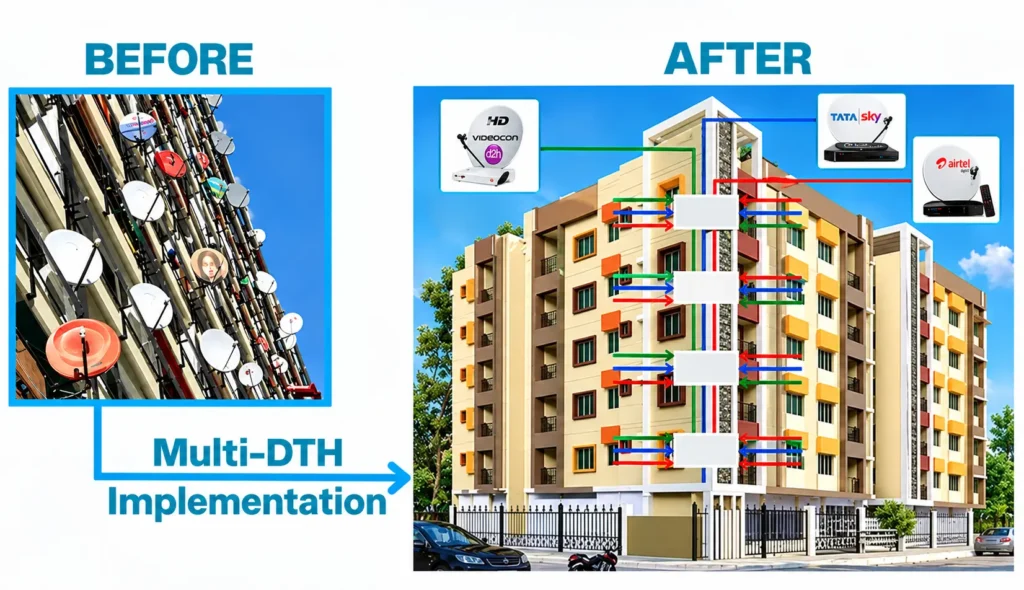
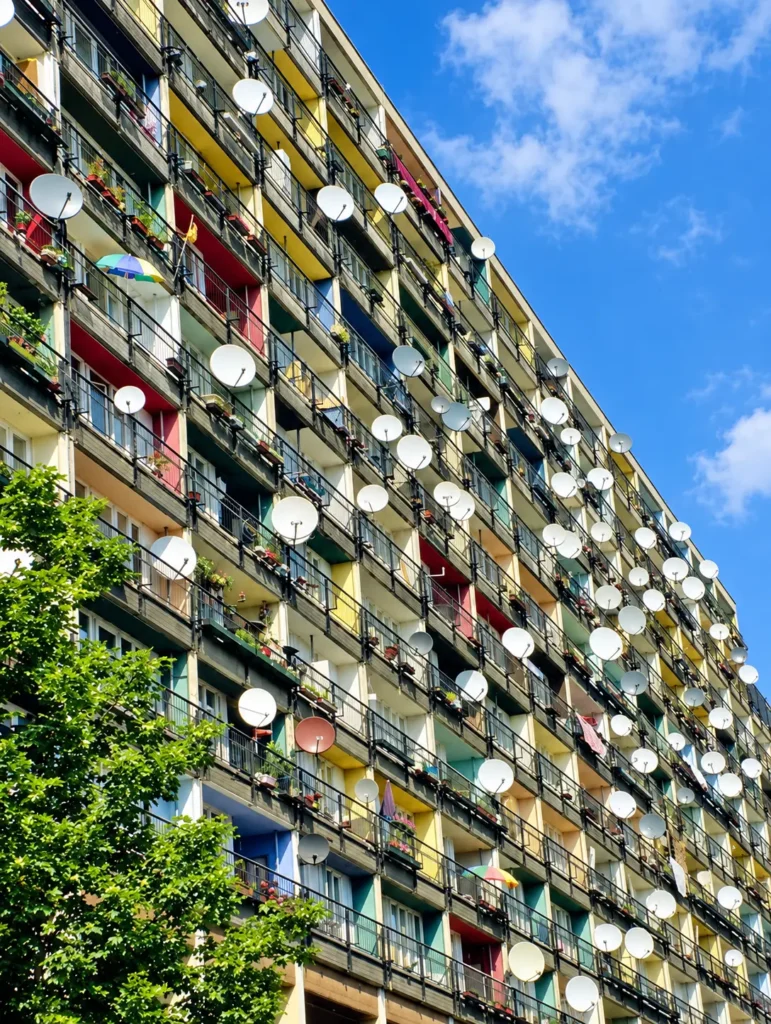
In today’s fast-paced digital world, uninterrupted television connectivity has become an essential requirement for residential, commercial, and hospitality environments. Whether it is an apartment complex, a hotel, a hospital, a hostel, a corporate office, or a gated community, users expect access to high-quality television services without interruptions. Traditionally, Direct-to-Home (DTH) television services required every subscriber to install a separate dish antenna, resulting in multiple dishes mounted on rooftops and balconies. This approach often creates visual clutter, increases maintenance requirements, consumes valuable installation space, and raises overall infrastructure
costs.
To overcome these challenges, Multi-Dwelling Unit (MDU) services have emerged as a modern and efficient solution. MDU technology centralizes the reception and distribution of satellite television signals, allowing multiple subscribers within a building to share a common infrastructure. Instead of installing individual dish antennas for each user, a centralized system distributes signals to numerous homesorroomsthrough astructured cabling network. This significantly improves building aesthetics, reduces operational costs, and simplifies maintenance while ensuring reliable signal quality.
As urbanization continues to increase and modernresidential and commercial buildings become more densely populated, MDU systems are gaining popularity due to their scalability, efficiency, and ability to support future technological integrations. This article explores MDU services in detail, including their working principles, types, features, benefits, advantages, limitations, and applications.
What is MDU (Multi-Dwelling Unit) Service?
MDU (Multi-Dwelling Unit) service is a centralized television signal distribution system specifically designed for buildings containing multiple subscribers. Rather than deploying separate dish antennas for eachresidentorroom,an MDU setup uses one or two centralized dish antennas to receive satellite signals.
These signals are then distributed through a structured network to multiple set-top boxes (STBs) located throughout the building.
MDU systems are widely used in:
• Apartments and residential complexes
• Hotels and resorts
• Hospitals and health care facilities
• Corporate offices
• Educational institutions
• Hostels and dormitories
• Commercial buildings
• Gated communities
The centralized architecture makes television signal management easier while ensuring efficient utilization of infrastructure resources.
How MDU Services Work?
The operation of an MDU system follows a systematic process designed to provide reliable signal distribution across multiple users.
1. Central Dish Installation
One or more satellite dish antennas are installed at a common location, typically on the rooftop or terrace of the building. The location is selected to ensure unobstructed access to satellite signals.
2. Signal Reception
The centralized dish antenna receives television signals transmitted from satellites operated by DTH service providers.
3. Signal Processing and Distribution
The received signals are processed through multi-switches, amplifiers, splitters, and distribution equipment. These devices ensure that signals maintain strength and quality while being distributed to multiple subscribers.
4. Structured CablingNetwork
A structured cabling infrastructure carries the signals from the distribution system to various apartments, rooms, or offices within the building.
5. Set-Top Box Connectivity
Each subscriber uses an individual set-top box connected to the centralized distribution network. The STB decodes the signals and delivers television content to the user’s television set.
6. Customized Deployment
MDU systems can be designed according to building size, occupancy levels, future expansion requirements, and service expectations. This flexibility makes them suitable for both small and large scale deployments.
Types of MDU (Multi-Dwelling Unit) Services:
1. Analog MDU System
An Analog MDU (Multi-Dwelling Unit) system distributes analog television signals from a centralized satellite dish antenna to multiple users through coaxial cable networks. The received signals are amplified and shared across various apartments, rooms, or offices with in a building. These systems are relatively simple and economical to install, making them suitable for small residential buildings or properties with basic television requirements. However, analog systems offer lower picture quality, limited channel capacity, and reduced scalability compared with modern digital solutions. As digital broadcasting technology has become the industry standard, analog MDU systems are gradually being phased out.
2. Digital MDU System
A Digital MDUsystem distributes digital satellite television signals from a centralized source to multiple subscribers. Using advanced signal processing equipment, digital headends, amplifiers, and multi switches, the system delivers high-definition video and superior audio quality to individual set top boxes. Digital MDU solutions provide improved signal reliability, support a larger number of channels, and allow easy expansion when additional subscribers need connectivity. Due to their excellent performance, scalability, and support forHD content, digital MDU systems are widely usedin modern apartments, hotels, hospitals, and commercial buildings.
3. SMATV(Satellite MasterAntennaTelevision) System
SMATV(Satellite Master Antenna Television) is a centralized television distribution system that uses a single master satellite dish antenna to receive television signals and distribute them throughout an entire building. The system is designed to provide uniform channel access to multiple rooms or apartments while minimizing the need for individual dish installations. SMATV offers centralized control, simplified maintenance, organized cabling, and consistent signal quality across all connected users. It is commonly deployed in hotels, hospitals, educational institutions, and large residential complexes where efficient and cost-effective television distribution is required.
4. Hybrid MDU System
A Hybrid MDU system combines multiple communication and entertainment services within a single integrated infrastructure. Along with traditional DTH satellite television distribution, it supports IPTV (Internet Protocol Television), CCTV surveillance systems, and data communication networks. This centralized approach enables efficient management of multiple services while reducing infrastructure complexity. Hybrid MDU systems are ideal for smart apartments, IT parks, and commercial buildings. hotels, and modern residential communities. They offer greater flexibility, scalability, improved operational efficiency, and future-ready connectivity, making them a preferred choice for advanced building communication networks.
Features of MDU Services
MDU services provide several important features that make them highly attractive for modern infrastructure projects.
Centralized Signal Distribution
Asingle dish antenna setup distributes signalsto multiple users, reducing hardware requirements.
Structured Cabling
Organized cabling ensure sneat installations and simplifies maintenance activities.
High-Quality Signal Transmission
Signal amplifiers and distribution equipment maintain strong,stable television signals throughout the building.
Scalability
New users can be added without installing additional dish antennas or significantly modifying existing infrastructure.
Reduced External Clutter
The elimination of multiple dish antennas enhancesthe building appearance and architectural aesthetics.
Multi-Operator Support
Certain MDU systems can accommodate signals from multiple DTH service providers.
Integration Capabilities
Modern systems can integrate with IPTV, CCTV surveillance,telecom infrastructure, and other building management technologies.
Benefits of MDU Services
Improved Building Appearance
One of the most visible benefits of MDU systems is the removal of multiple dish antennas from balconies and rooftops. Buildings maintain a cleaner,more professional appearance.
Lower Installation Costs
Instead of purchasing and installing individual dish antennas for every subscriber, the cost is distributed across a shared infrastructure.
Simplified Maintenance
Technicians only need to manage a centralized system, reducing maintenance complexity and service downtime.
Consistent Signal Quality
Centralized signal amplification ensuresstable reception across all connected users.
Easy Expansion
As occupancy increases, additional users can be connected without major infrastructure modifications.
Space Optimization
Shared infrastructure eliminates the need for numerous dish installations, saving valuable rooftop and balcony space.
Support for Smart Infrastructure
MDU systems can be integrated with modern communication technologies, helping buildings transitiontoward smart infrastructure solutions.
Advantages of MDU Services
The growing adoption of MDU systems can be attributed to several operational and financial advantages.
Cost Efficiency
Centralized infrastructure significantly reduces equipment procurement and installation expenses.
Operational Simplicity
Managing one centralized system is easier than maintaining dozens or hundreds of individual dishantennas.
Enhanced Reliability
Professional-grade distribution equipment improves signal stability and minimizes disruptions.
Flexible Deployment
MDU solutions can be customized to meet the unique requirements of residential, hospitality, healthcare, and commercial environments.
Future Scalability
As user demands increase, the system can be expanded without major redesigns.
Technology Integration
Support for IPTV, CCTV, and data services enables comprehensive communication infrastructure with in a single network.
Applications of MDU Services:
MDU (Multi-Dwelling Unit) services are widely used across various sectors that require efficient and centralized television signal distribution. In the residential sector, they are commonly deployed in apartments, high-rise buildings, residential townships, and gated communities to provide reliableTVconnectivity to multiple house holds. In the hospitality industry, hotels, resorts, guest houses, and hostels utilize MDU systems to deliver consistent television services to guests while reducing infrastructure complexity.
Healthcare facilities such as hospitals, medical centers, andpatient accommodation units use MDU solutions to provide entertainment and information services topatients and visitors. Educational institutions, including universities, colleges, and student hostels, benefit from centralized signal management and cost-effective connectivity.
MDU systems are also Extensively used in commercial buildings such as corporate offices, business parks, and shopping complexes where multiple television connections are required. Furthermore, they play a significant role in smart building projects, integrated residential developments, smart city initiatives, andmixed- use infrastructure projects by supporting scalable, organized, and future-ready communication networks. These diverse applications highlight the flexibility, efficiency, and reliability of MDU technology across modern residential, commercial, and institutional environments.
Why Choose UNISOL for MDU Services?
UNISOL is a trusted provider of MDU (Multi-Dwelling Unit) solutions, offering reliable and efficient TVsignal distribution systemsfor apartments, hotels, hospitals, hostels, and commercial complexes. Withexpertise in centralized DTH distribution, SMATV systems, structured cabling, and fiber opticconnectivity, UNISOL ensures seamless television services through a single, organized infrastructure.
The company provides professional design, installation, and maintenance services tailored to specific building requirements. By reducing multiple dish installations, improving signal quality, and supporting future expansion, UNISOL helps create cleaner, more efficient, and cost-effective communication networks.
With quality products, expert technical support, and scalable solutions, UNISOL delivers smart, reliable, and future-ready MDU systems for modern residential and commercial environments.
Conclusion
MDU (Multi-Dwelling Unit) services represent a modern, efficient, and scalable solution for television signal distribution in multi-user environments. By centralizing satellite signal reception andutilizing structured distribution networks, MDU systems eliminate the need for multiple dish antennas, reduce maintenance complexity, improve aesthetics, and lower long-term operational costs. Their ability to deliver reliable signal quality, support future expansion, and integrate with technologies suchas IPTVand CCTV makes them an ideal choice for contemporary residential, commercial, hospitality, and healthcare facilities.
As buildings continue to evolve toward smarter, more connected infrastructures, MDU services will playa critical role in ensuring efficient communication and entertainment delivery. Organizations, property developers, and facility managers seeking cost-effective, organized, and future-ready television distribution solutions can greatly benefit from implementing MDU technology.